Also known as the Azadi Tower or the National Monument of Pakistan, construction began on 23 March 1960 and was completed in 1968. The architect was Nasreddin Murat-Khan, and the tower stands roughly 62 to 70 m tall, blending Mughal and modern architecture.
The tower stands on a raised, star-shaped platform, with steps leading up through four levels of stone. A narrow staircase and a lift take visitors to the viewing gallery near the top.
The tower: A slender, curved structure rising high above the park, visible from across the old city.
Four platforms: Rough hammered stone, pebbled stone, chiselled stone and polished white marble, rising level by level.
Marble tablets and inscriptions: Quranic verses, the 99 names of Allah, the Lahore Resolution in Urdu, Bengali and English, and national poetry and speeches.
Viewing gallery: A top-level viewpoint with a wide view of Lahore, including Badshahi Mosque and Lahore Fort on a clear day.
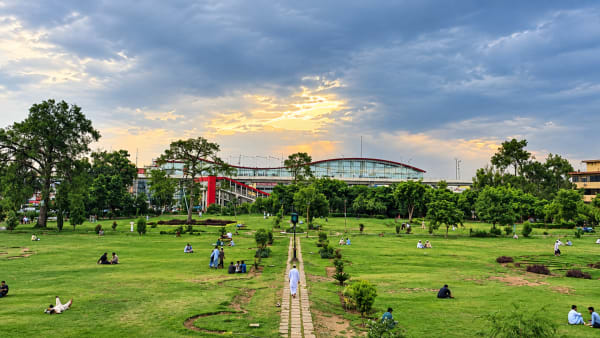
Greater Iqbal Park: A large green space around the tower, with lawns, walking paths, a lake and fountains.
Evening lighting: The tower and park are lit up at night, which makes it one of the most photogenic spots in the city.
Late afternoon brings soft light and cooler air, and the evening illumination is best for photos.