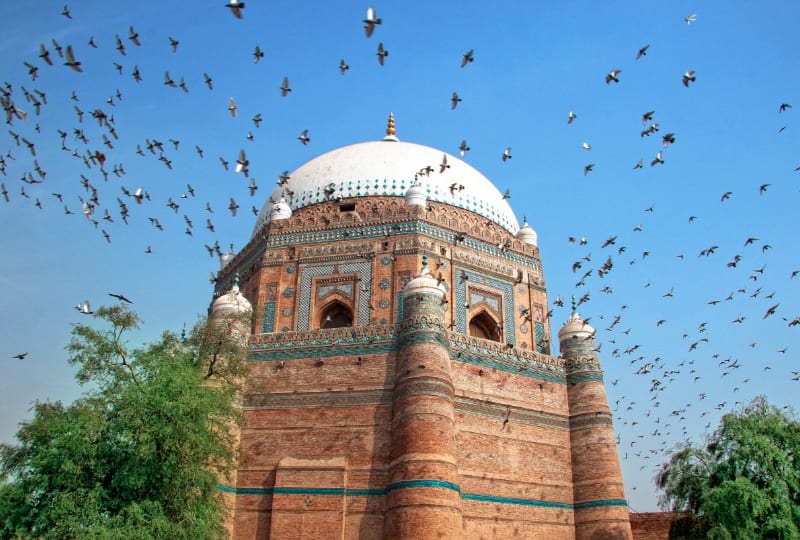
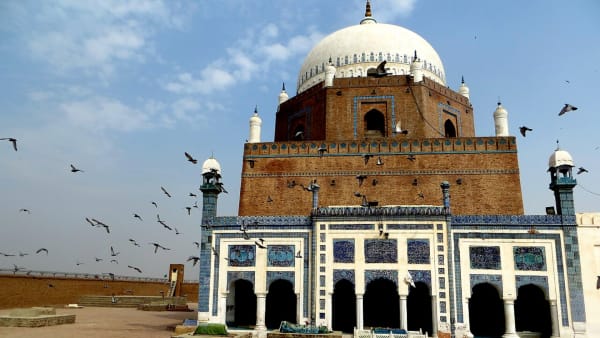
Also known as the Shrine of Hazrat Shah Rukn-e-Alam or Mazar Shah Rukn-e-Alam, it is dedicated to Sheikh Rukn-ud-Din Abul Fateh, known as Shah Rukn-e-Alam, a leading Suhrawardi Sufi saint and the grandson of Hazrat Bahauddin Zakariya. It was built in the early 14th century during the Tughlaq period, commonly dated to the 1320s, in Tughlaq-era baked brick with glazed blue and turquoise tilework and carved timber. The octagonal tomb is crowned by a large dome on a raised platform, standing roughly 35 m for the tomb itself and about 51 m in total including the platform and dome.
The tomb stands on a high platform within the Qila Kohna Qasim Bagh area, and visitors approach it through the shrine complex. Inside, the octagonal chamber holds the grave of the saint beneath the great dome.
The octagonal tomb: An eight-sided structure with sloping walls and corner turrets, a design closely linked to the Tughlaq style.
The dome: A large, rounded dome, among the biggest in the region, rising above the tomb chamber.
Glazed tilework: Bands of blue, turquoise and white tile set into the brick, which glow in the late afternoon sun.
Carved timber and brick detail: Wooden beams and brick patterns that reinforce the structure and add decoration.
The inner chamber: A calm, quiet space where devotees offer prayers and recite verses.
Courtyard and mosque area: Open spaces around the tomb where visitors rest and pray.
Views from the fort mound: The raised ground gives wide views of the old city and nearby shrines.
Nearby shrine of Hazrat Bahauddin Zakariya: Just a short walk away, linked by the same Sufi lineage.
Late afternoon is especially beautiful, when the tiles take on deeper colours and the dome catches the warm light.